- FEATURED ARTICLE
The Journey: Part II
How Resistance, Grace, and Difficulty Shape Our Greatest Contributions
Tim Reed
Share
Listen to the audio article.
[He] looked up, and fell off his bicycle. Before him stood the Tree, his Tree, finished. If you could say that of a Tree that was alive, its leaves opening, its branches growing and bending in the wind that [he] had so often felt or guessed, and had so often failed to catch. He gazed at the Tree, and slowly he lifted his arms and opened them wide. ‘It’s a gift’ he said. He was referring to his art, and also to the result; but he was using the word quite literally. He went on looking at the Tree. All the leaves he had ever laboured at were there, as he had imagined them rather than as he had made them; and there were others that had only budded in his mind, and many that might have budded, if only he had had time. Nothing was written on them, they were just exquisite leaves, yet they were dated as clear as a calendar. Some of the most beautiful—and the most characteristic, the most perfect examples of [his] style—were seen to have been produced in collaboration with Mr. Parish: There was no other way of putting it.
—J.R.R. Tolkien
If you’re anything like me, you’ve always wanted to live a life that matters. One that’s weighty—substantive. A life that, when the scales are set, tips the balances of purpose, meaning, and impact. Now, the longer we live, the more we hopefully understand what a mixed bag our motives are; but, regardless, we can’t shake the God-shaped imprint that compels us to try and make the most of what we’ve been given. I believe that life ultimately comes down to this: We’ve been given a blessing, and that blessing can either be shared with others as an act of worship, or it can rot and mold if we keep it to ourselves.
I never set out to get into the fireplace industry. I never set out to become a sales manager. I never set out to start a digital magazine, a podcast, or a software company. But over and over again, acts of grace, providence, and love found me despite my thickheadedness, and I couldn’t escape them. And after years of what is, hopefully, long obedience in the same direction in response, I’m still trying to fully step into who I’m made to be.
Over time, I’ve learned that there’s no greater teacher than a good punch in the face—and even though it sucks in the moment, that suffering can be a gift that strengthens your resolve and clarifies your vision in a way that simply wasn’t possible before. Over the last five years, there have been a lot of ups, a lot of downs, and a lot of punches to the face—but when I look at the fruit that’s grown as a result, I can’t help but be thankful for what those hardships have produced.
Over time, I’ve learned that there’s no greater teacher than a good punch in the face—and even though it sucks in the moment, that suffering can be a gift that strengthens your resolve and clarifies your vision in a way that simply wasn’t possible before.
I believe that everyone has a contribution to make, but many don’t make it because they’re too smart to risk failure, too concerned about their ego and status, or too afraid of what other people think.
But for those of us who don’t know any better, who are too naive for our own good, and who are foolish enough to ask, “Why not me?” there’s a chance to make a contribution of real significance—even if you don’t see it come to fulfillment.
If that’s the place where you find yourself, I hope this article encourages you to persevere in the midst of adversity, difficulty, and resistance to make a contribution of substance as well.
+++
In November of 2020, momentum was high. We’d just released the prototype issue of The Fire Time Magazine, and we were on top of the world. The mainstay publication of our industry had just closed its doors, and the opportunity was wide open to provide a new voice to the industry—one specifically geared toward helping retailers grow their business and create prosperity for themselves and the people they serve.
Grant Falco and I had each made a personal investment to get the business off the ground, and, suffice to say, money was tight. But it didn’t matter. We could afford a part-time editor (my friend, Matt Bradley) and a part-time graphic designer (my sister, Christy Campbell), and, with the last of our budget, we contracted two writers from the former industry publication—everything else was volunteer. And these volunteers were incredible. We had a team of industry rockstars who believed in the cause, and they were really living it. This wasn’t a publication made to write fake advertorial articles that pumped up whoever had the biggest checkbook or write stodgy industry surveys where out-of-touch executives talked about how they “expected a strong third quarter.” It felt like Brendan Fraser screaming at the station manager in Airheads: “Don’t talk to me about rock n roll! I’m out there in the clubs on the streets, and I’m living it—I am rock n roll!” We were rock n roll. This was the real deal.
And everything was in place. We built our own app to release the magazine through, we released the prototype issue in November so the industry could see what it would be like, and we spent the next few months securing advertising before starting our monthly releases in March. The president of the Hearth, Patio & Barbecue Association (HPBA) had given his personal blessing and written a cover letter for the debut issue. On top of that, I’d called every distributor and manufacturer that I knew to talk about advertising, and they all said that they wanted in.
What could go wrong?
Well, you know what they say about wounds from friends and kisses from enemies, right?
+++
Six months later, I was in one of the darkest points of my life. I’d just been kicked off the HPBA national board for a perceived conflict of interest from starting The Fire Time Magazine—and I was furious. The situation made me sick to my stomach, and I felt completely betrayed. On top of that, most of the companies that had so eagerly said they wanted to advertise with us had backed out.
But in the midst of it, the magazine was pumping out incredible content, and dealers were loving it. Over and over, we were getting emails and phone calls from retailers overjoyed to read about things that directly affected them. Forget articles about new product releases—they wanted to know how to manage their installation schedules more effectively!
At the same time, we did have some awesome advertisers that came through and supported the cause. We are forever indebted to Associated Energy Systems (AES) and ICC Chimney in particular for believing in what we stood for and supporting it from day one.
One of the things I learned during that time is that people view the world in one of two ways—either with a scarcity mindset or an abundance mindset.
A scarcity mindset believes the pie is a fixed size and any competitor with a piece is a threat to you getting yours. (I once asked the head of a prominent manufacturer in our industry if he wanted his dealers to win, and he responded, “Only if they’re selling our fireplaces.” Yikes.)
But an abundance mindset believes that the pie can grow. Yes, competition exists, but we don’t care how big someone else’s slice is because we have limitless potential to get our own.
A scarcity mindset can protect you for a long time. It can provide a cush job, a corner office, and a great salary—but it kills the ability to innovate and make a contribution of any significance.
In hindsight, I think that we made manufacturers nervous in the early days. We weren’t going to let advertising affect the content of the magazine, and we weren’t going to write puff pieces because someone spent a lot of money with us. We were going to write the best content we could to help retailers grow their companies, pay their people well, and enjoy the fruit of running a great business.
Holding an abundance mindset requires faith—trust—that the world isn’t a zero-sum game. That there’s always enough to go around. And that generosity is a superpower. Sure, it leaves you open to being taken advantage of, but it also leaves you open to doing something that makes a real difference.
Holding an abundance mindset requires faith—trust—that the world isn’t a zero-sum game. That there’s always enough to go around. And that generosity is a superpower.
This article is brought to you by Associated Energy Systems.

+++
In January of 2022, the world ran out of paper. I mean it. The world ran out of paper.
A number of months earlier, we had the idea to produce a printed publication that would come out once a year—and the vision was really coming together. Inspired by the look, feel, and content of the quarterly Evangelization & Culture produced by Word on Fire, we were going to create The Fire Time Journal.
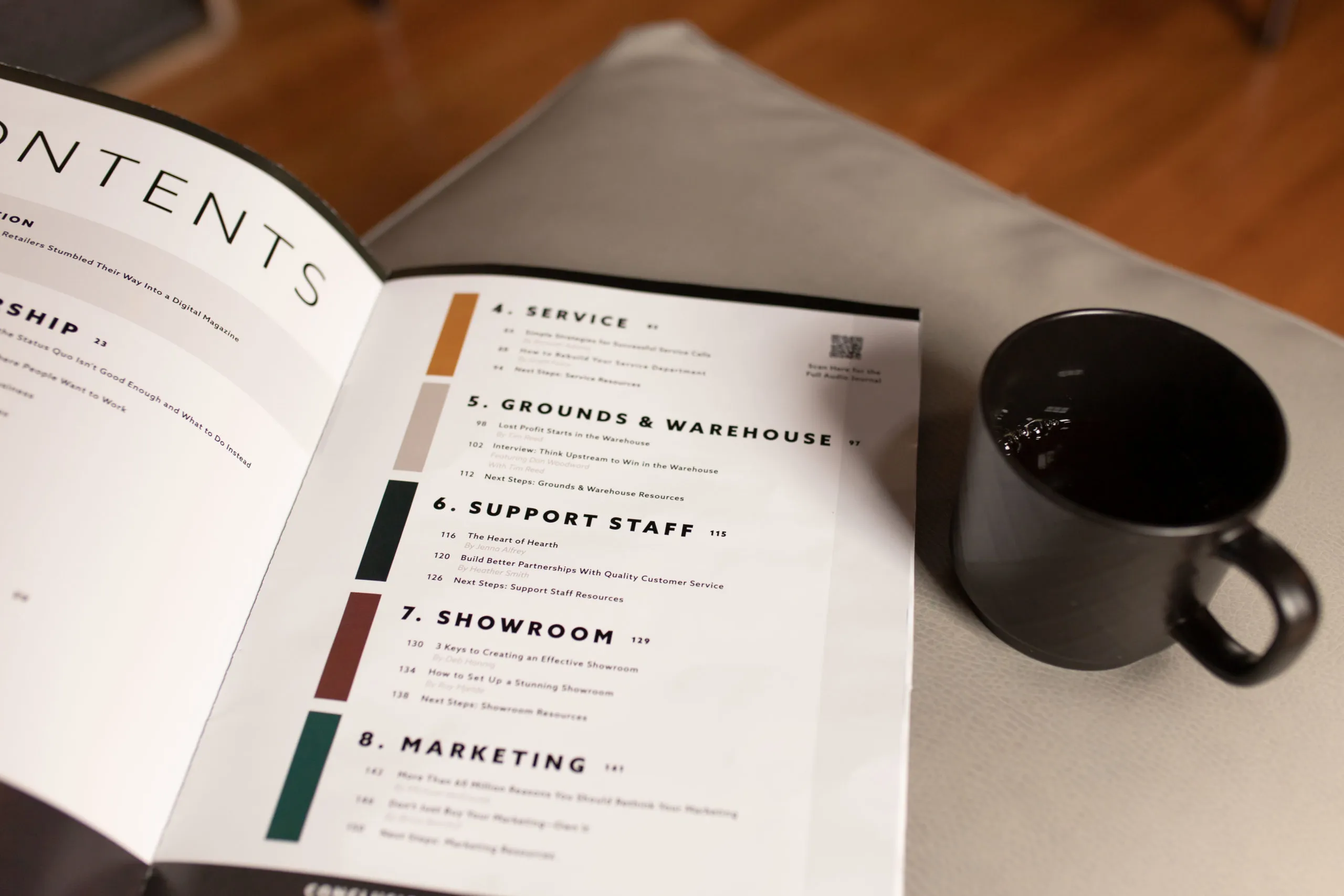
The goal was simple: In the spirit of Tom Pugh’s Blueprint for Success, we’d create a playbook for running a hearth business. Organized by the eight departments of a retail company—Leadership, Sales, Installation, Service, Support Staff, Grounds and Warehouse, Showroom, and Marketing—we’d use a combination of the best articles of the year, plus new pieces, commissioned specifically for the journal. On top of that, I’d write a personal opening and closing letter for the journal, we’d preface each section with an inspiring quote, we’d use QR codes to link out bonus content, and we’d make the entire thing an audiobook as well.
In addition, we wanted the journal to look amazing. It had to be beautiful. It had to feel right. And it needed to make someone feel inspired simply by holding it.
Our goal was to give them away at the HPBExpo in Atlanta in a couple of months. We had a 10-foot by 10-foot booth, and we decided to give journals away to everyone we could. We’d found an online vendor who could get them printed for us. We’d spent weeks going back and forth with them on quantity, size, color, and shipping details to make sure we got it right.
Everything was perfect. Until we placed the order.
I got a call a few days later from a nervous customer service rep from the publishing company, who let me know that they were unable to source the volume of paper needed for our order. They had print houses all over the U.S., and none of them had access to that amount of paper. They offered us a full refund, but we were absolutely stuck.
Now, we’d already sold advertising for this publication, so we had to find a way to get it printed. I started calling print shops all over the country, trying to see if anyone was able to take on the project and ship the journals out to Atlanta before the tradeshow—and no one could. One day, as I was calling vendors, my wife reminded me that a family friend owned a printing business about an hour away from us. She encouraged me to check with them. I made the phone call, and they said there was a chance.
I immediately drove down to Albany, Oregon to meet with the print shop, which, in an act of providence, was less than a mile away from where Christy, our graphic designer, lives. We sat down with them, and they determined that they could get their hands on the paper, but it was going to be expensive. And, boy, was it. The new quote was nearly double what we had budgeted, and deciding to print it meant losing many thousands of dollars on the journal. What’s more, the timeline would come down to the absolute wire, but they guaranteed they could do it.
With a smile and a prayer, we said yes.
+++
Two months later, we were in Atlanta—and the journals weren’t there.
We’d arrived at the HPBExpo a couple of days early and had been watching the tracking number like a hawk—even getting the number of local trucking dispatchers to make sure the journals made it onto the next truck. But due to hiccups in shipping, they weren’t going to make it in time for the opening of the show. We’d been pumping up the journal release at the Expo to all of our readers and advertisers, and we had no idea how we would get rid of all the copies if we didn’t give them away at the tradeshow.
According to the tracking, they were going to arrive, but not until the second day of the show. I called the printing company to explain the situation, and, in an act of total unmerited grace, they offered to overnight 750 copies of the journal to us on their dime. I was floored. They knew how important this journal was to us—and that we had sacrificed all of our profit margin to produce it—and they were willing to do the same to make sure we had it.
Knowing that we would get the journals midday of the first day of the expo, we immediately brainstormed how we could make the splash with the cards we’d been dealt, and Grant came through like a magician pulling a rabbit out of his hat. He said we should throw an industry happy hour at the end of that first day to celebrate the release of the journal and give away copies to everyone who attended. We created a signup form and sent it out to all of our subscribers at the Expo, and the results were staggering. This wasn’t going to be just a few dozen people at a casual happy hour; it was going to be an army.
Somehow, Grant convinced the OMNI hotel in Atlanta to open up a bar on the mid-level that was supposed to be closed, called up AES to see if they wanted to sponsor it, and secured enough money for a drink ticket for each attendee.
To this day, I have never seen the level of joy at an industry event that was captured at that happy hour. Over 200 people showed up to get their copy of the journal. There’s a moment cemented in my head where I saw presidents of three bitter competitors smiling and laughing as they shared a drink and chatted. Industry friends were reconnecting. Hugs were abounding. And, in the midst of it all, people were sitting down to read the journal—right then and there—regardless of the noise around them.
I’ll never forget some of the comments I heard. One retailer told me she broke down in tears after reading the opening letter to the journal. Another said that receiving the journal was worth the entire cost of the cross-country trip to Atlanta. A husband and wife who owned a retail shop together said that the journal gave them a new hope for their business that wasn’t there before.
Yes, we made no money. Yes, it only came together because of the grace of others. But like the widow’s mite, the sacrifice is what makes the gift substantial.
Like the widow’s mite, the sacrifice is what makes the gift substantial.
+++
We rode that momentum as long as we could, but in June of 2022, I got a text from Grant that the unthinkable had happened—his mom, Kristi Falco, had been diagnosed with cancer. It was terrible. He already had a more than full-time job running Falco’s (his family business in Spokane), plus his Fire Time Magazine work, plus the workshops, speaking, and consulting that the two of us were doing. It was clear that something had to give so he could be there for her. He said that he had to step back from most of his Fire Time responsibilities because taking care of his mom had to be his first priority. The team completely agreed and promised to shoulder the load wherever he wasn’t able to contribute.
The problem was that Matt and I already had more than full-time jobs as well with running WhyFire, and with Christy’s duties as a full-time stay-at-home mom—on top of her graphic design work—there wasn’t a lot of extra time to take on Grant’s responsibilities.
We limped through the year, going back and forth with Grant where we could, but it was really hard. He was crushed by guilt for not being there for the team, and we were trying to forge ahead the best we could, not knowing what we could expect from him. It was bad all the way around.
But as we neared the 2023 HPBExpo in Louisville, things took a turn. Looking to capitalize on the momentum from our Fire Time Journal debut at the previous year’s tradeshow, we wanted to take things up a notch—and we had an incredible idea on how to do it.
For the last few years, we’d felt like the opening keynote of the tradeshow had been underwhelming, and we wanted to deliver something that gave real value to the folks at the show. So, our idea was to host a series of TED-style talks after the first day of the show about the past, the present, and the future of our industry. The best part? After the success of last year’s happy hour, we had a manufacturer approach us that wanted in on this event, so we started collaborating.
Finally, we had a legit budget, and with our combined power to promote the event, we were convinced it was going to take the industry by storm.
But then things got weird.
The deeper we got down the path of planning the event, it became clear that our two sides weren’t aligned—and it ultimately came down to money. We felt like they were strong-arming us with their checkbook, and they probably thought we were too big for our boots.
In hindsight, I think both were true.
So, we made the decision to back out and put it on ourselves, and the race was on. We put the word out, found sponsors to help cover the cost, and started promoting like crazy. The response was overwhelming—hundreds and hundreds of RSVPs were coming in. We couldn’t believe it, and we even convinced the venue to upgrade us to a bigger room in light of all the attendees.
It was all coming together. The perfect event at the perfect venue at the perfect moment. But that March, I learned a lesson I’ll never forget about human behavior and the danger of overconfidence.
The day of the event came, and I’ll never forget walking into the venue. A legit stage, green rooms, professional lighting, and stadium seating for about 700—I couldn’t wait to blow the roof off this place.
The doors opened, and a handful of people sauntered in. That’s to be expected—it was across town from the expo center, so people naturally may be a little late. But as showtime came closer and closer, it was clear that we had seriously misjudged how many people were going to show up.
The event was okay. Looking back on it, I’m still really happy with the talk I gave, and we actually had pretty good attendance, just not nearly enough to make a 700 capacity venue look full. But that event shook us to the core—Grant in particular. The effort, time, and stress that it had taken to pull off were way too much. I’ll never forget finding him in tears at the side of the stage afterwards—and how crushed he felt. We put everything into this, thinking it would be our time to break through into the limelight—and, it actually was, just not in the way I ever imagined.
+++
In July of 2023, I clicked the link on a video call in my calendar to meet with Jill McClure, the new President and CEO of the HPBA. The longtime president had retired about three months earlier, and it was clear that things were changing. I’d met Jill in passing, but this was the first time we’d been able to chat extensively since she had stepped into her role.
I don’t know what I expected going into the call, but what amazed me was Jill’s desire to serve the industry, her ability to listen, and her shameless audacity to ask—and answer—difficult questions that would be easy to sweep away.
We talked for a long time (I think that call was over three hours), mostly about my observations on the state of the industry, how we needed to prepare for the future, where we could help heal schisms, and what we could do together to help retailers thrive in today’s landscape.
At the end of the call, I was sure of three things: (1) Jill was someone I could trust, (2) her ability to make decisions of consequence would help avoid mistakes of the past, and (3) her insistence to confront the brutal facts of the situation—no matter how severe—was the only chance our association had to avoid sliding into irrelevance.
Now, in the meantime, Grant had stepped completely out of his day-to-day duties at Fire Time—the load he was carrying was just too much. We were still partners, but there were more important things in his life that demanded his attention. I filled him in where I could with the developments with HPBA and our new-forged partnership, but most of our conversations revolved around how his mom was doing. He still carried a huge burden of guilt that he wasn’t able to help, but there was nothing that could be done about it.
Jill and I continued to meet over the course of the year, and it was clear that there was a ton we could do together to help our industry. More than anything, under Jill’s leadership, I saw a transformation in how the association operated from a posture of fear to one of possibility. And this started with the national board. As I talked with people who were on it, they believed in the vision and felt like they had a tangible role in making it take shape. This wasn’t Jill’s plan that they needed to rubber-stamp; this was their plan that she was helping put into action.
As the tradeshow took shape for 2024, Jill asked me to be a part of shaping—irony of ironies
—the opening session. It turned out that she had actually attended our event the year before and made it just in time to watch my presentation. She understood the vision, so much so that she wanted to craft the 2024 HPBExpo opening session in a similar format.
It was all coming together: We had momentum and alignment in a way that we’d never had before; the content in the magazine was getting better and better; and it would only be a matter of time before Grant could step back in and rejoin the team.
+++
That November, Grant’s mom passed away after battling cancer for over a year. It was devastating. She was an incredible mother and grandmother, a faithful wife, and an integral part of why Falco’s had been so successful over the years. In the midst of her battle, Grant had been in the process of buying the business from his parents (a months-long process that was complicated to say the least).
Grant’s mom had managed all of the finances for Falco’s, and her passing meant that the process of sorting everything out for the sale was going to drag out even further. As he went to work preparing for her celebration of life, sorting out the finances of the business, and working to hold his family together in the midst of this horrible tragedy, it didn’t look like there was an end in sight to his hiatus from our company.
The date for a celebration of life was set for January. We had already planned a family trip to central Oregon that weekend—about three hours away from our home in Portland—but looking into it, I could drive to the nearby town of Redmond, catch a flight to Spokane, and be there for the service before flying back later that night to rejoin my family on our trip.
The weather that weekend was terrible. Oregon was rocked by a blizzard like we hadn’t seen in years. The drive out to central Oregon was so gnarly that we almost didn’t make it, even with four-wheel drive and chains. When I woke up at 4:30 on Saturday morning to fly to Spokane, it was almost whiteout conditions, and getting to the airport was a near miracle. The plan was to fly from Redmond to Portland (just a 30-minute jaunt over the Cascade mountains), where I’d have a short layover, then take the 45-minute trip to Spokane and make it in plenty of time for the service.
But the conditions were so terrible that the flight kept getting pushed back. As I watched the minutes until my connecting flight in Portland took off shrink away, they finally made the call to get us on the plane and over the mountains. I’ve never had such a terrifying flight in my life; those 30 minutes felt like an eternity. The snow was pounding so hard that I couldn’t see anything out the windows, and the plane was pummeled by the wind from every direction. At multiple points, people were shrieking and screaming. (I’ve never found the “Our Father” so helpful in my entire life as on that flight.) When we finally landed, all flights in Portland were halted, and there was nothing to do but wait. Eventually, they made the call to cancel everything. I called Grant, and he completely understood, but it absolutely sucked.
The situation was straight out of “Planes, Trains, and Automobiles.” My family was three hours away in Central Oregon in a blizzard with no vehicle. My vehicle was at the Redmond airport waiting for me to fly home later that night. I was stuck in Portland, Oregon—my hometown—in the middle of a blizzard with keys to a car that wasn’t there. Ultimately, I ended up renting a car in Portland, buying chains for it to drive back over the mountains I’d just flown over to get my car from the Redmond airport and rejoin my family. I didn’t make it back to them until nearly midnight—a little late, but a little wiser too.
+++
A couple of months later, Matt and I were in Orlando at the National Chimney Sweep Guild (NCSG) national convention. We’d been going to that show for a couple of years and would always bring as many copies of The Fire Time Journal as we could to give away.
Now, shipping multiple copies of The Fire Time Journal is no easy task because it’s larger than your average publication, and due to the thickness of paper, it weighs significantly more as well (pick up a box of journals and you’ll swear it weighs a metric ton). Suffice it to say, we figured out that the cheapest way to get Fire Time Journals from one side of the country to the other was to add them as checked bags on an Alaska Airlines flight after booking the flight with an Alaska Airlines credit card. Being that the airlines have a strict policy of 50 pounds for a checked bag, my wife and I mastered the art of duct-taping together cardboard to make a custom box that could hold 49.5 lbs of Fire Time Journals (according to our bathroom scale).
In standard fashion, Matt and I had checked as many of these boxes as we possibly could, and—in true John Candy form—had lugged them into the show that day. I was teaching a class in the morning called “Creating a Framework of Sales Management,” and we got there early to set out copies of the journal for everyone who would be attending.
While I was grabbing a glass of water before going up to the front, a guy pulled me aside who owned a chimney business somewhere in the Southeast. He told me that he’d been reading and listening to all of the content the magazine was putting out and thanked me for “proclaiming the gospel” to our industry. He said the magazine and podcast had given him so much hope and guidance for his business that he wanted to make sure he said something to me in person.
The next month, we were back in Florida, this time for the United Buyer’s Group (UBG) show in Sawgrass, and the show was just wrapping up. As we packed up our booth, Matt and I noticed Gary Yoder from Stoll Industries a ways off. Now, I’d sold Stoll for years when I was a retailer, and I loved their generous spirit and the way they approached business. If memory serves, I’d even talked with Gary on the phone before, but I’d never met him face to face. Matt and I introduced ourselves and gave him a copy of The Fire Time Journal. I told him that we loved what Stoll was doing with their company and the heart they had to serve their dealers. It turned out he was familiar with The Fire Time Magazine, and he looked at me and said something really powerful: “Those articles are spreading good news to people in our industry who need hope.”
Stuff like that is incredible—and honestly, we hear it everywhere we go. Not always from droves and droves of people, but time and time again, Matt and I have found that, in every corner of the continent that we travel to, there’s somebody reading or listening to The Fire Time Magazine, taking it to heart, and acting on it. That’s what it’s all about.
+++
By the spring of 2024, things hadn’t improved for Grant. He was still neck deep in the process of buying the business from his father, on top of running the business day in and day out. We would text back and forth, but we’d also go long periods without actually talking.
On the magazine side, we’d been making some huge changes. We’d started producing audio versions of most articles, and we made the painful decision to shut down the Fire Time Magazine app we’d created and release the magazine through our website. This was a little bit of an ego hit for me because I’d been such a champion of the app at the beginning, but there was no question the magazine was easier to read, easier to produce, and easier to share when we released it through our website—and this is where having a team around you that isn’t afraid to tell you the truth is a treasure that all should aspire to have.
I tried to keep Grant in the loop with what was going on, but it was hard. He was still racked by guilt that he was letting us down, and we didn’t know what to do about it. One day, Grant called me and said that he needed to get something off his chest. He talked about how hard the last couple of years had been for him. He said that it was hard for him to call me or pick up the phone when I called because he felt embarrassed that he wasn’t doing his part for the Fire Time team. At one point, he said something I’ll never forget: “I need to get my friend Tim back, but that can’t happen until I don’t feel guilty about our partnership anymore.”
On that phone call, we made the decision that my wife and I would buy Grant out. We didn’t decide on a number at the time, but a little while later, he gave us one, and Jessica and I agreed. I flew out to Spokane a little while later to pick up the stock of Fire Time Journals that Grant was holding onto at Falco’s, rented a U-Haul truck, and drove them seven hours back to Portland. But on that trip, Grant and I grabbed lunch, and it was just like old times. As hard as the entire process was for everyone, it’s cool that, after all of it, we were able to get back to what was most important—being friends with nothing in the way.
+++
As the corner turned to 2025, Jill reached out to me and asked if I could be a part of the opening session and co-host the industry awards show with her again at the HPBExpo in New Orleans, and I was honored to participate.
But the preparation took hours. And I mean hours. Between thinking through the structure of the events, creating content, meeting with the other speakers, collaborating with Jill, coordinating with the HPBA, and rehearsing in-person, the investment was easily north of 50 hours. And it was hard to find that much time to say the least.
The theme for the opening session was “Leading Through Times of Change and Uncertainty.” As I worked to frame out what I was going to say, it really came down to three things. First, when things around you are uncertain, you have to be able to understand the waters that you’re swimming in—and that means becoming a student of the game with the humility to learn. Second, you need to hold fast to your principles and values—because this is the only thing that will provide stability when everything else around you is moving. And third, you have to be willing to change course without losing sight of your ultimate destination.
I think it took shape like that because it’s literally been the journey of our company from the beginning. And it was clear from the response of the audience in that opening session that it was the story of many of their companies too. Sometimes what we need isn’t more information, but rather just confirmation that continuing to do the right thing over and over again will take us where we need to go.
Sometimes what we need isn’t more information, but rather just confirmation that continuing to do the right thing over and over again will take us where we need to go.
On the final night of the tradeshow, we hosted the second annual HPBA Ultimate Awards Show, and it was truly a full-circle moment for me. Two years earlier, almost to the day, I was speaking to a half-empty room about the future of our industry, and my team was desperately trying to give away copies of The Fire Time Journal to anyone we could. That night, I was representing our company as I announced friends and mentors to come up to receive awards and be honored by over 1,000 people in attendance (to be clear, I had absolutely zero role in who was going to win what).
What was it that caused the shift?
Well, in the words of Jim Collins, we have to understand that not all time is equal. Here’s the idea: Imagine you’re a minor league pitcher, and one day you get a call that the Yankees’ bus broke down and they won’t make it to the game, so they ask if you can pitch. That moment in time is significantly more important than others because, if you pitch well, you might get asked to pitch again. So, regardless of what else is going on, if you get the chance to pitch at Yankee Stadium, you clear the calendar and get to the ballpark.
We should always be on the lookout for moments where time is of particular significance—and be willing to cut things out to make space for it. Most people miss out because they’re either not able to sacrifice what’s easy for what’s best, or they haven’t put in the reps to be asked to pitch in the first place.
Of course, there’s no guarantee that you’ll get asked to pitch at Yankee Stadium. And that’s okay. Because the contribution we make isn’t about shining on the biggest stage or under the brightest lights. Instead, it’s about making a difference wherever we can, whenever we can, for whoever we can, and being content with the results—whatever they may be.
And, in many ways, the smaller the scale, the better. Because little things matter more than we know, and I believe they’ll receive their reward in due time.
+++
In January of 2026, I began my fifth decade on this earth. And crossing that threshold forces you to face the reality that you aren’t young anymore. Life is going to look different on the back half than the front half. Suffering isn’t a matter of “if,” but a matter of “when.” And our looming expiration date is something that simply can’t be escaped.
So what should we do with the waning time that remains?
Rather than dyeing our hair, getting a divorce, buying a sports car, or asking how we can maximize our pleasure—which is a guaranteed path to futility and despair—I think we should ponder a different question.
What contribution is so worth making that you’re willing to do it even if it fails?
That’s what you should give your time to.
I have no idea how long The Fire Time Magazine or podcast will last. Money is tight. The hours are long. And the burden is real. But we have an incredible team, and this work has been worth doing, even if it all goes away tomorrow.
I’ve made a lot of mistakes in my life, and there’s nothing I’ve done to earn or deserve the things I’ve been given. All of it’s been an act of grace.
And as painful as they are in the moment, the resistance, the difficulty, and the punches to the face have shaped our company—and strengthened our determination—to make a contribution. A contribution that hopefully shines a light to illuminate the path for others.
So we glory in our suffering. Because suffering produces perseverance; perseverance produces character; and character produces hope.
Hope that lasts doesn’t come from flavor-of-the-week hacks to get ahead; it doesn’t come from a strategic plan for the next five years; it doesn’t come from more money in your bank account. Hope comes from character that’s been forged through perseverance in light of suffering—plain and simple. This is certainly true for individuals, and it’s also true for companies.
And, more than ever, I feel hope for the future. I hope you do too.
I’m so thankful for Grant starting this with me; for Matt, Christy, and my wife, Jessica, for their contribution and sacrifice; and for all of our volunteers, advertisers, readers, and listeners for their belief in the community we’ve created together.
From the beginning, this journey has been a labor of love. We prepare for the future the best that we can, but there’s no five-year plan.
We know we’re playing with house money.
The only thing we have is our daily bread—which we trust is enough for today.
And tomorrow will worry about itself.
Want to get free content like this every month?

Tim Reed
Tim Reed is the President of WhyFire, where he helps business leaders in the hearth industry take control of their companies by providing them with sales tools to save time and make money. He's also the host of The Fire Time Podcast, which is actively helping thousands of people grow themselves—and their companies.


