It’s a Gas
Fourteen years ago, I listed 10 reasons why natural gas “will be a key fuel of the future.” Since then, global gas use has grown faster than any other form of energy.
Robert Bryce
Share
Publication Note: The Fire Time Magazine appreciates the opportunity to republish this article, which was originally released on July 22, 2025. It is reprinted with permission from Robert Bryce. Be sure to subscribe to his Substack. Further use, duplication, or distribution is prohibited without the author’s written permission.

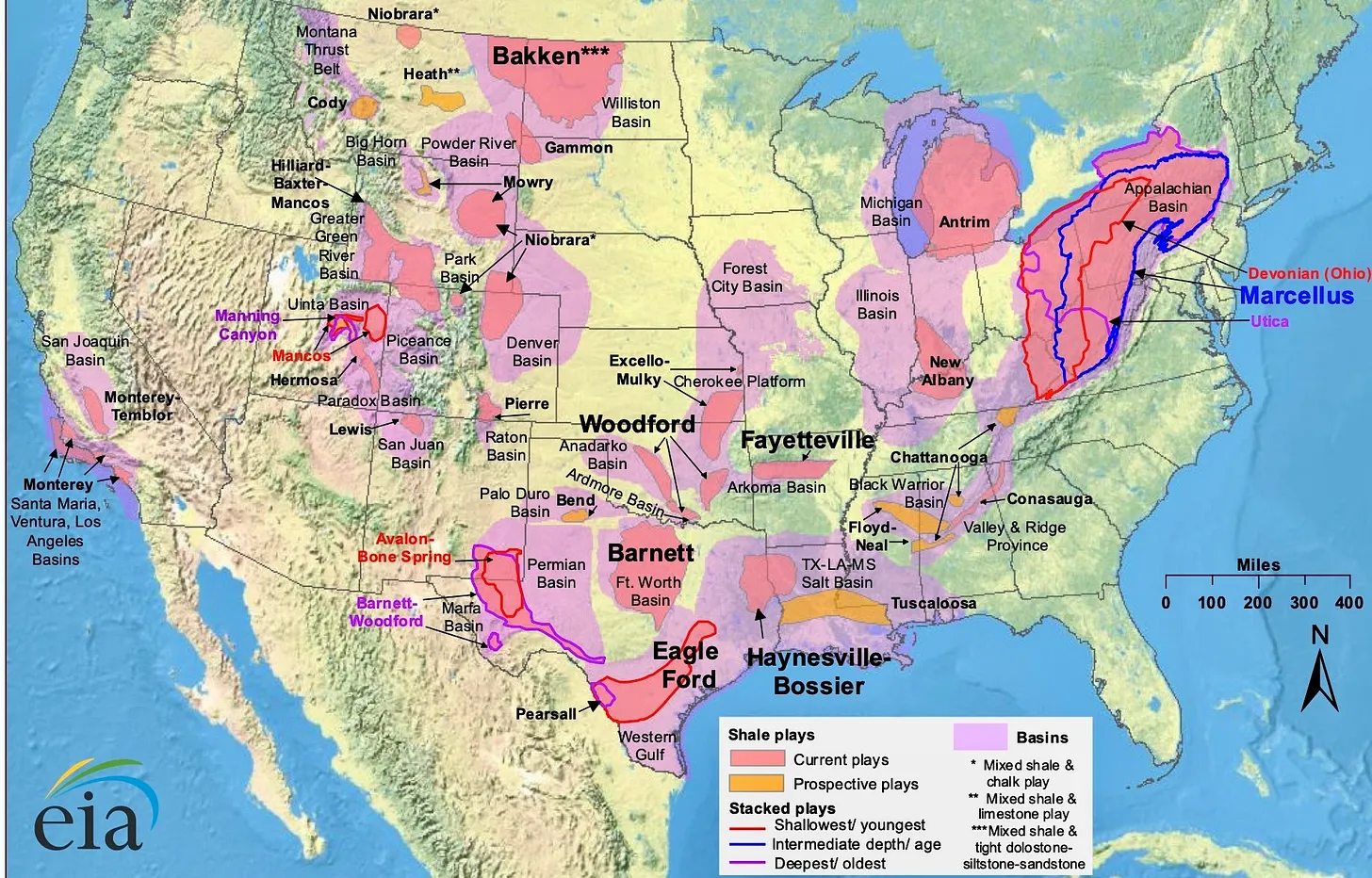
Shale plays in the continental U.S. Credit: EIA and Wikimedia.
In 2011, I wrote a report on natural gas called “Ten Reasons Why Natural Gas Will Fuel The Future.” I’m pleased to say that my thesis has stood the test of time. Given the increased focus on natural gas, its growing role in U.S. electricity generation, its critical role in the expansion of AI and data centers, and surging LNG exports, it’s appropriate to revisit that 14-year-old report.
Looking back, it’s remarkable to see how U.S. gas production has grown. It’s grown so much that the U.S. is now the world’s largest LNG exporter. In addition, since 2011, global gas use has grown faster than any other form of energy, accounting for 35% of the increase in primary energy use.
Here’s a condensed version of that 2011 report, along with two charts that show the stunning growth in global gas use and the surge in U.S. gas production.
I’ll start with one of the charts.

Between 2011 and 2024, global energy use increased by about 91 exajoules (EJ). As seen above, nuclear energy barely grew at all over that time frame. Hydropower outgrew it a little bit (3.5 EJ). Meanwhile, coal, solar, and wind all contributed about the same amount of energy, about 7 EJ each. However, the biggest growth occurred in oil and gas, with gas use surging by 32.1 EJ.
Introduction
In less than five years, the natural gas business has gone from shortage to surfeit. Technological breakthroughs have unlocked massive quantities of natural gas from shale deposits that were previously thought to be uneconomic. The result: The United States no longer needs to import huge quantities of natural gas. Domestic gas resources should easily last many decades.
Relatively inexpensive, abundant supplies of natural gas will affect everything from electricity generation to petrochemical production. And while the effects of what is now known as the shale gas revolution will be felt most quickly in the United States, the technologies behind that revolution are going global. In late January 2011, ONGC, the Indian energy company, announced that it was producing gas from a shale gas well in West Bengal. The well is the first productive shale gas well located outside of the United States or Canada. Other shale deposits, located in Poland, France, Australia, and China, could also yield vast quantities of oil and gas.
The impact of the shale gas revolution can be seen in a report put out in January 2011 by the International Energy Agency (IEA), which estimated global gas resources at 32,000 trillion cubic feet (Tcf), the energy equivalent of about 6 trillion barrels of oil. The IEA’s latest estimate is more than double the estimate for global gas resources that it put forward in 2008.
A significant portion of that gas is in the United States. In June 2009, the Potential Gas Committee, a U.S. nonprofit organization, put domestic gas resources at 2,074 Tcf—the highest resource evaluation in the committee’s 44-year history. That quantity of gas is the energy equivalent of more than 350 billion barrels of oil, or about three times as much as the proved oil reserves of Iraq.
The dramatic jump in the estimates of gas resources is due to increased production of “unconventional” gas, a term given to gas produced from geologic formations with low permeability. Shale deposits, coal beds, and tight sands all have low permeability. For decades, drillers were unable to extract profitable quantities of natural gas from those low-permeability deposits. But in recent years, drillers have perfected two techniques that have long histories in the oil and gas industry: horizontal drilling and hydraulic fracturing. The combination of these techniques is unlocking vast quantities of hydrocarbons.
This paper provides 10 reasons why natural gas continues to gain market share and why it will be a key fuel of the future.
1. Natural Gas Saves Consumers Money
Between 2005 and 2008, U.S. natural gas prices averaged about $7 per million British thermal unit (BTU). But thanks to surging production, natural gas prices in 2010 had fallen to an average of about $4.25 per million BTU. That price reduction of about $3 per million BTU is now saving U.S. consumers about $65 billion per year or about $180 million per day, savings which are particularly important in an economy characterized by high rates of unemployment, stagnant wages, and rising prices for commodities such as corn, oil, coffee, sugar, and copper.
That price reduction of about $3 per million BTU is now saving U.S. consumers about $65 billion per year or about $180 million per day, savings which are particularly important in an economy characterized by high rates of unemployment, stagnant wages, and rising prices for commodities such as corn, oil, coffee, sugar, and copper.
Consumers are saving money because U.S. drillers are producing record amounts of natural gas. In 2010, U.S. natural gas production was 21.5 Tcf, only a bit shy of the production record (21.73 Tcf) set in 1973. And the nation is using more natural gas than ever. In 2010, consumption hit a record 24.1 Tcf, an increase of nearly 6% over 2009 levels.
Even better news may be ahead. Analysts are expecting a sustained period of robust gas production and relatively low prices.
2. If It’s Not Going to Be Nuclear, It’s Got to Be Gas
In response to the accidents at the Fukushima reactors in Japan, electricity generators around the world have announced plans to slow, or even halt, the development of new reactor projects. And environmental groups have seized on the problems in Japan to promote their anti-nuclear agenda. For instance, on March 26, 2011, some 200,000 protesters took to the streets in Berlin and other German cities to urge that country’s leaders to abandon nuclear energy altogether.
But if nuclear energy is taken off the table, then natural gas is the only non-coal energy source that can provide dispatchable electricity generation in the volumes needed and at affordable prices. Concerns about global carbon dioxide emissions provide yet another argument for natural gas, which produces about half as much carbon dioxide during combustion as coal. Furthermore, unlike coal, natural gas produces almost no air pollutants and no solid waste.
Although some environmental groups and a few politicians are using the Fukushima mess to push for increased use of renewables, wind energy, and solar energy, they simply cannot provide the vast quantities of electricity that the world demands at prices consumers can afford. And even if they could overcome the daunting challenges of cost and scale, wind and solar energy remain, by nature, intermittent and highly variable. That intermittency and variability can only be overcome by deployment of widespread, ultra-cheap energy storage—which does not exist—or through continuous backup from natural gas-fired generation.
When it comes to producing large quantities of electricity while reducing air pollution, solid waste production, and carbon dioxide emissions, nuclear energy has no rival. But if policymakers are squeamish about promoting nuclear energy, then natural gas is the next best option.
3. Natural Gas Is Abundant, and the Globalization of the Gas Market Is Accelerating
Surging gas production in the United States is being matched by increased natural gas availability around the world. Indeed, global markets are now awash in gas. And last November, the IEA’s chief economist, Fatih Birol, said that the world is oversupplied with gas and that “the gas glut will be with us 10 more years.”
This surfeit of gas stems from soaring production of unconventional gas as well as huge increases in natural gas liquefaction capacity in countries such as Qatar, Russia, and Nigeria. Although the United States—and the rest of the world—is producing and using more natural gas than ever, gas resources continue to grow apace. It is one of the great paradoxes of the global gas business: The more gas the world uses, the more gas it finds. In 1970, about 10 countries were producing more than 1 billion cubic feet of gas per day. By 2009, 41 countries were producing at least 1 billion cubic feet of gas per day.
In 2008, global gas liquefaction capacity was 280 billion cubic meters. By 2013, total capacity is expected to grow by nearly 50% to some 410 billion cubic meters. In 2009 alone, four major LNG liquefaction projects—Sakhalin II, Yemen LNG, Tangguh, and Qatar Mega Trains—came online.
The globalization of the LNG market is occurring at the very same time that the domestic need for LNG imports has largely disappeared. The sudden flood of unconventional gas has made the United States largely self-sufficient in natural gas. That point was made succinctly by Ian Cronshaw of the IEA in October 2009 when he said, “The United States is now a virtual liquefied natural gas exporter because all the LNG that was supposed to be going there is now going somewhere else.”
4. Unconventional Gas Is Driving Unconventional Oil Production
The revolution in unconventional gas has fostered breakthroughs in unconventional oil. By using horizontal drilling and hydraulic fracturing on low-permeability formations, drillers are now unlocking huge quantities of liquid hydrocarbons. Those breakthroughs are reshaping the U.S. oil business, a sector that has been on a long, steady decline since production peaked in the early 1970s. In 2010, U.S. crude oil production was 5.5 million barrels per day, the highest level since 2003. And some analysts are now predicting that domestic oil production could increase by as much as 1 million barrels per day over the next five years.
One of the hottest oil plays in the United States is located in the Permian Basin. Variously known as the Wolfcamp, or Wolfberry play, the shale formation sits near the middle of a region that has likely seen more drilling over the past fifty years than any other place in the United States. And just as in other shale plays, drillers in the Wolfcamp are using hydraulic fracturing with great success. In October 2010, Texas oil production averaged 1.2 million barrels per day. That’s the highest level of production in the Lone Star State since February 2000.
The increasing push for unconventional oil is having a knock-on effect on natural gas production. As more companies are drilling for oil in low-permeability reservoirs, they are also producing significant quantities of natural gas. The economic returns from oil-focused drilling depend largely on the value of the liquids extracted, not the gas. For some operators, therefore, the gas that comes up alongside the liquids is, from an economic perspective, essentially free. The likely result of this increased push for unconventional oil production is that domestic production of natural gas will continue rising in the years ahead, resulting in downward pressure on prices.
5. Unconventional Oil Production Is Stimulating the U.S. Petrochemical Sector and Global Oil Production
In September 2010, U.S. production of NGLs hit a record 2 million barrels per day. That surging production of ethane and other NGLs has spurred several petrochemical companies to announce major expansion plans. CP Chem and Eastman Chemical have both announced plans to restart production at dormant plants. And in December 2010, Dow Chemical said it was going to upgrade its capacity to crack ethane (high-temperature cracking is one of the first steps in the petrochemical production process) in the United States by up to 30% over the next three years. Indeed, for the first time in decades, petrochemical producers and refiners are saying that the United States has a competitive advantage over the rest of the world due to the abundance of low-cost feedstock and relatively cheap natural gas.

This is the other new chart, which I made using the latest numbers from the Statistical Review.
The U.S. is both the world’s biggest producer and consumer of natural gas. With some 2.2 million miles of gas pipelines, it has the world’s most extensive gas distribution network.
6. The United States’ Huge Gas Production Capability, and Its Vast Gas Infrastructure, Make It Uniquely Well Positioned to Take Advantage of the Shift to Natural Gas
The U.S. is both the world’s biggest producer and consumer of natural gas. With some 2.2 million miles of gas pipelines, it has the world’s most extensive gas distribution network. In addition, the U.S. has more natural gas storage capacity than any other country; its 4 trillion cubic feet of natural gas storage capacity is 10 times the capacity of France and nearly six times that of Germany. Gas storage provides a vital buffer against transportation and supply interruptions. Furthermore, the U.S. is home to the biggest, most transparent, and most liquid gas trading market.
7. Increasing Regulatory Pressure on the Coal Sector Is Leading Electricity Generators to Switch to Natural Gas
Owners of coal-fired power plants are facing a myriad of regulatory challenges, including increasingly stringent standards on air quality, restrictions on heavy metals emissions, and possible new rules on the management of coal ash. Add in the possibility of taxes or caps on carbon dioxide emissions, and coal’s disadvantages become even more apparent.
Coal’s share of the power market has been flat since the mid-1990s. In fact, between 1997 and 2009, the amount of electricity generated by coal actually declined slightly, falling from 1,845 billion kilowatt hours to 1,764 billion kilowatt hours. During that same time period, nearly all the growth in U.S. electricity generation came from natural gas. In November 2010, analysts at Deutsche Bank estimated that 60 gigawatts of older, inefficient, coal-fired generation capacity will be retired by 2020, and another 92 gigawatts will be retired by 2030. And most of that 152 gigawatts of capacity will be replaced by natural gas-fired units. Deutsche Bank estimates that coal’s share of U.S. electricity generation will fall from nearly 50% today to about 22% by 2030.
Natural gas produces no solid waste, an attribute that has become increasingly important since the failure of a coal-ash holding pond operated by the Tennessee Valley Authority in late 2008. The spill flooded some 300 acres with coal ash contaminated with a variety of heavy metals, including arsenic, lead, barium, chromium, and manganese. That accident has led the EPA to consider rules that could classify coal ash as a hazardous waste under the Resource Conservation and Recovery Act. Even if the agency takes a less-aggressive approach and only requires generators to change the management of their coal ash, the per-plant cost of that change could approach $30 million.
8. Low-Cost Natural Gas Means Lower-Cost Electricity
There are many reasons why natural gas will retain a cost advantage over other forms of electricity generation. Perhaps the most important: In some areas of the United States, natural gas is now cheaper than coal. The cost advantage with regard to fuel makes gas even more attractive when you consider other key factors. Among those factors: Gas-fired power plants have shorter lead times than other forms of conventional generation. A gas-fired plant can be built in about two years. A comparable coal plant could take twice as long. In the wake of Fukushima, the permitting process for a new nuclear plant in the United States is likely to become extremely lengthy. Finally, when compared to coal-fired electricity generation, natural gas dramatically cuts emissions of the two most problematic air pollutants—sulfur dioxide and nitrogen oxide—by 100% and 80%, respectively.
9. Two Key Trends—Decarbonization and Urbanization—Favor Increased Use of Natural Gas
Decarbonization is a trend that was first identified by a group of scientists that included Nebosa Nakicenovic, Arnulf Grübler, Jesse Ausubel, and Cesare Marchetti. They found that over the past two centuries, consumers in nearly every country around the world wanted the cleanest, densest forms of energy and power that they could find. The decarbonization trend can be understood by looking at the ratio of carbon to hydrogen atoms in the most common fuels. From pre-history through the early 1800s, wood was the world’s most common fuel. Wood has a carbon-to-hydrogen ratio (C:H) of about 10:1. That is, it contains about 10 carbon atoms for every hydrogen atom. But wood lost its dominance to coal, which has far higher energy density, and a C:H ratio of about 2:1. Coal lost out to oil, which has an even higher energy density as well as being easier to handle. In addition, oil has a C:H ratio of about 1:2. Now we are seeing the rise of natural gas, which, as its chemical symbol (CH4) suggests, has a C:H ratio of 1:4, or one carbon atom for every four hydrogens. In 2005, Italian physicist Cesare Marchetti wrote about the decarbonization trend and declared that for the next five decades natural gas “is to be the dominant primary energy.”
In 2005, Italian physicist Cesare Marchetti wrote about the decarbonization trend and declared that for the next five decades natural gas “is to be the dominant primary energy.”
The second key trend, urbanization, has been the focus of a spate of recent books. Edward Glaeser says that cities “have been the engines of innovation since Plato and Socrates bickered in an Athenian marketplace,” and that “urban density provides the clearest path from poverty to prosperity.”
Stewart Brand, the California-based entrepreneur and environmentalist, is also a big fan of cities, calling them, “the greenest things that humans do.” In his 2009 book, Whole Earth Discipline, Brand writes that “Every week there are 1.3 million new people in cities. That’s 70 million a year, decade after decade. It is the largest movement of people in history.” As millions more move into cities, they are living in much closer proximity. That proximity, by necessity, requires the use of easily transported, clean-burning fuels. That largely disqualifies bulky fuels such as wood and coal.
10. Global Electricity Demand Is Growing Rapidly
The essentiality of electricity to modernity is incontrovertible. As tens of millions of people move from the countryside into cities, they want what nearly all urban dwellers take for granted: cheap, abundant, reliable electricity. And the trend toward electrification shows no sign of slowing. Over the past two decades, electricity use has grown faster than any other type of fuel consumption. Between 1990 and 2007, electricity use increased by about 68%; that’s nearly three times as fast as the growth in oil consumption over that period. And demand for electricity will continue to grow. In late 2010, the IEA projected that global electricity demand will soar by some 80% by 2035. The vast majority of that electricity will have to be produced from hydrocarbons. And the hydrocarbon of choice will be natural gas.
Want to get more content like this from Robert Bryce? Click below to subscribe to his Substack.

Robert Bryce
Robert Bryce is a Texas-based author, journalist, podcaster, film producer, and public speaker. Over the past three decades, his articles have appeared in numerous publications including the Wall Street Journal, New York Times, National Review, Field & Stream, and Austin Chronicle. He has given nearly 400 invited or keynote lectures to dozens of groups including the Marine Corps War College, Sydney Institute, Jadavpur University, Northwestern University, and a wide variety of professional associations and corporations. He has also appeared on dozens of TV and radio shows, including NPR, BBC, MSNBC, Fox, Al Jazeera, CNN, and PBS.


